Sunday, October 2, 2022

Coding computers with sign language

I am one of those people who searches slightly outside the parameters of the near term actual with an eye toward the long term feasible, for the purpose of innovation and curiosity. I'm not a futurist, but a probable-ist, looking for the ways we can leverage the technologies and tools we have at our fingertips today to achieve adjacent potential opportunities leveraging those tools. There are millions of people at any time thinking how to address new applications of any specific technology in novel ways to push the technological capabilities toward exciting new utilities. We often invent the same things using different techniques, the way that eyes and wings evolved via separate paths in nature, called convergent evolution. I remember going to a Google developer event in 2010 and heard the company announce a product that described my company's initiative down to every granular detail. At the time I wondered if someone in my company had jumped the fence. But I then realized that our problems and challenges are common. It's only the approaches to address them and the resources we have that are unique.

When I embarked into app development during the launch of the iPhone, I knew we were in a massive paradigm shift. I became captivated with the potential that we could use camera interfaces as inputs to control the actions of computers. We use web cameras to send messages person to person over the web. But we could also communicate commands directly into code as well if we leverage an interpretive layer to communicate as the computer interprets.

This fascination with the potential future started when I was working with the first release of the iPad. My developer friends were toying around with what we could do to extend the utility of the new device beyond the bundled apps. At the time, I used a Bluetooth keyboard to type, as speech APIs were crude and not yet interfacing well with the new device and because the in-screen keyboard was difficult to use. One pesky thing I realized was that there was no mouse to communicate with the device. Apple permitted keyboards to pair, but they didn't support the pairing of a Bluetooth mouse. Every time I had to place the cursor, I had to touch the iPad, and it would flop over unless I took it in my hands. 

I wanted to use it as an abstracted interface, and didn't like the idea that the screen I was meant to read through would get fingerprints on it unless I bought a pen to touch the screen with. I was acting in an old-school way wanting to port my past computer interaction model to a new device while Apple wanted iPad to be a tactile device at the time, seeking to shift user expectations. I wanted my device to adapt to me rather than having me adapt to it. "Why can't I just gesture to the camera instead of touching the screen?" I wondered.

People say necessity is the mother of invention. I often think that impatience has sired as many inventions as necessity. In 2010 I started going to developer events to scope out use cases of real-time camera input. This kind of thing is now referred to as "augmented reality" where the interaction of a computer overlays some aspect of our interaction with the world outside the computer itself. At one of these events, I met an inspirational computer vision engineer named Nicola Rohrseitz. I told him of my thoughts that we should have a touchless-mouse input for devices that had a camera. He was thinking along the same lines. His wife played stringed instruments. Viola and cello players have trouble turning pages of sheet music or touching the screen of an iPad because their hands are full as they play! So gesturing with a foot or a wave was easier. A gesture could be captured by tracking motion rendered through light color shifts on pixel locations of the camera chip. He was able to track the shift of pixel color locally on the device and render that as input to an action on the iPad. He wasn't tracking the hand/foot directly, he was post-process analyzing the images after they were written into random access memory (RAM). By doing this on device, without sending the camera data to a web server, you avoid any kind of privacy risk of a remote connection. So having the iPad think about what it was seeing, it could interpret the input as a command and thereafter turn the page of sheet music on his wife's iPad. He built an app to to achieve this for his wife's use. And she was happy. But it had much broader implications for other actions.

What else could be done with signals "interpreted" from the camera beyond hand waves we wondered? Sign language was the obvious one. We realized at the time that the challenge was too complex then because sign language isn't static shape capture. Though ASL alphabet are static hand shapes, most linguistic concept signs have a hand position shifting a certain direction over a period of time. We couldn't have achieved this without first achieving figure/ground isolation. The iPad camera at that time did not have a means for depth perception. Now a decade later, Apple has introduced HEIC image capture (a more advanced image compression format than JPEG) with LIDAR/depth information that can save layers of the image available, much like the idea of multiple filter layers in a Photoshop file.

Because we didn't have figure/ground isolation, Nicola created a generic gesture motion detection utility which we applied to allow users to play video games on a paired device by use of hand motions and tilting rather than pushing buttons on a screen. We decided it would be fun to adapt the tools for distribution with game developers. Alas, we were too early with this particular initiative. I pitched the concept to one of the game studios in the San Francisco Bay Area. While they said the game play concept looked fun, they said politely that there have to be a lot more mobile gamers before there would be demand among those gamers to play in a further augmented way with gesture capture. The iPad had only recently come out. There just wasn't any significant market for our companion app just yet.

Early attempts to infer machine models of human or vehicle motions would overlay an assumed shape of a body over a perceived entity in the camera's view. In a depiction of a video intake of a driving car, it might be inferred that every object in the field of view represented by a moving object is a car. (So being a pedestrian or biker in the proximity of self-driving cars became risky as object and behavior assumptions of the seeing entity predicted different behaviors than pedestrians and bicyclists exhibited.) In a conference demo on an expo floor, it is likely that most of what the camera sees are people, not cars. So the algorithm can be set to infer body position represented by the assumed skeletal overlays of legs related to bodies, and presumed eyes atop bodies. The purpose of this program pictured below was to be used in shop windows to notice when someone was captivated by the displayed items in the window. For humans near, eyes and position of arms were accurately projected. For humans far away, less so. (The Computer Electronics Show demo did not capture any photographs of the people moving in front of the camera. I captured that separately with my camera.)

Over the ensuing years, other exciting advancements brought the capture of hand gestures to the mainstream. With the emergence of VR developer platforms, the need for alternate input methods became even more critical than the early tablet days. With the conventional technique of wearing head-mounted-displays (HMDs) and glasses, it became quite obvious that conventional input methods like keyboard and mouse were going to be too cumbersome to render in the display view. So rather than trying to simulate a mouse and keyboard in this display, a team of developers at LeapMotion took the approach of utilizing an infrared camera which could detect hand position, then infer knuckle and joint positions of the hands which could in turn be rendered as input methods to any operating system to figure out what they hands were signaling for the OS to do at the same time as they were projected into the head-mounted-display. (Example gesture captures could be mapped to commands for grabbing objects, gesturing for menu options, etc.)

The views above are my hands detected by infrared from a camera sitting below the computer screen in front of me, then passed into the OS view on the screen, or into a VR HMD. The joint and knuckle positions are inferences based on a model inside the OS-hosted software. The disadvantage of LeapMotion was that it required an infrared camera to be set up and for some additional interfacing challenges through the OS to the program leveraging the input. But the good news was that OS and hardware developers noticed and could pick up where LeapMotion left off to bring on these app-specific benefits to all users of next generation devices. Another five years of progress and the application of the same technology in Quest removes the x-ray style view of the former approach with something you can almost infer as realistic presence of one's own hands.

 
Hololens and Quest thereafter merged the former external hardware camera into the HMD directly facing forward. This could then send gesture commands from the camera inputs to all native applications on the device, obviating the need for app developers to toil with the interpretive layer of joint detection inside their own programs. In the Quest platform, app developer adoption of those inputs is slow at present. But for those that do support it, you can use "Hands API" to navigate main menu options and high-level app selection. A few apps like Spatial.io (pictured above) take the input method of the Hands API and allow the use of the inferred hand position to replace the role formerly filled by hardware controllers for Spatial content and motility actions. Becacuse Spatial is a hosted virtual world platform, the Hands API offers the user a capability to navigate within the 3D space through more direct hand signals. This lets the user operate in the environment with their hands in a way resembling digital semaphore. Like Spider Man's web-casting wrist gesture, a certain motion will teleport the user to a different coordinate in the virtually-depicted 3D space. Pinching fingers allows command menus to come up. Hovering over an option and letting go of the pinch selects the desired input command. The entire menu of the Spatial app can be navigated with hand signals much like the Spielberg film Minority Report's futuristic computer interfaces. It takes a bit of confused experimentation before the user's neuro-plasticity rewires the understanding of the new input method. (The same way learning abstract motions of the mouse cursor or game-pad controls require a short acclimatization period.)
 
This is great advancement for the minority of people reported to be putting HMDs on their heads to use their computers. But what about the rest of us who don't want to have visors on our noggins? For those users also we can anticipate computer input from our motions in front of the machine of our choice too, very soon. Already, the backward-facing camera in iOS devices detects full facial structure of the user. The depth vision of that camera enables mirroring of the shape of our facial features such that it can be used in a similar way that old skeleton keys precisely matched the internal workings of bolt locks. Simulating the precise shape of your face, plus the pupil detection of your eyes looking at the screen, is trustworthy indication that you are awake and presently expecting your phone to awaken as well. Pointing my camera at a photo of me doesn't unlock the phone, nor would someone pointing my phone at me while I'm not looking at it. As a fun demonstration of this capability, new emoji packs called "memoji" allow you to enliven a cartoon image of your selection with the CGI animation by mirroring your facial gestures. Cinematographers have previously used body tracking to enable such animation for films including Lord of the Rings and Planet of the Apes. Now everybody can do the same thing with position mirroring models hosted in their phones.

The next great leap of utility for cross-computer communication as well as computer programming will be enabling the understanding of other human communication beyond what our faces and mouths express. People video-conferencing use body language and gesture through the digital pipelines of our web cameras. Might gestural interactions be brought to all computers allowing conveyance of intent and meaning to the OS for command inputs?

At a recent worldwide developer convention, Apple engineers demonstrated a concept of using machine pattern recognition to simulate gestural input commands to the operating system extending and expanding the approach from the infrared camera technique. Apple's approach uses a set of training images stored locally on the device to infer input meaning. The method of barcode and symbol recognition with the Vision API pairs a camera-matched input to a reference database. The matching database can of course be a web query to a large existing external database. But for a relatively small batch of linguistic pattern symbols such as American Sign Language, a collection of reference gestures can be hosted within the device memory and paired with the inferred meaning the user intends to convey for immediate local interpretation without a call to an external web server. (This is beneficial for security and privacy reasons.)

In Apple's demonstration below, Geppy Parziale has the embedded computer vision capability of the operating system to isolate the motion of two hands separate from the face and body. In this example he tracked the gesture of his right hand separately from the left hand making the gesture for "2." Now that mobile phones have figure/ground isolation and the ability to isolate portions of the input image into segments, enormously complex gestural sign language semiotics can be achieved in ways that Nicola and I envisioned a decade prior. The rudiments of interpretation via camera input can now represent the shift of meaning over time that forms the semiotics of complex human gestural expression.


I remember in high school going to my public library and plugging myself into a computer, via a QWERTY keyboard, to try to learn the language that computers expect us to comprehend. But with these fascinating new transitions in our technology, future generations may be able to "speak human" and "gesture human" to computers instead of having us spend years of our lives adapting to them! 

My gratitude, kudos and hats off to all the diligent engineers and investors who are contributing to this new capability in our technical platforms.


Friday, September 9, 2022

Looking it up with computer vision

My mother introduced me to a wide range of topics when I was growing up. She had fascinations with botany, ornithology, entomology and paleontology, among the so-called hard sciences. As she was a teacher, she had adapted certain behaviors she'd learned from studying child development and psychology in her masters degree program on the best way to help a young mind to learn without just teaching at them. One of her greatest mantras from my childhood was "Let's look it up!" Naturally she probably already knew the Latin name for the plant, animal or rock I was asking about. But rather than just telling me, which would make me come to her again next time, she taught me to always be seeking the answers to questions on my own. 

This habit of always-be-looking-things-up proved a valuable skill when it came to learning languages beyond Latin terms. I would seek out new mysteries and complex problems everywhere I went. When I traveled through lands with complex written scripts that were different from English, I was fascinated to learn the etymologies of words and the way that languages were shaped. Chinese/Japanese script became a particularly deep well that has rewarded me with years of fascinating study. Chinese pictographs are images that represent objects and narrative themes in shape representation rather than in sound, much like the gestures of sign language. I'd read that pictographic languages are considered right brain dominant because understanding them depends of pattern recognition rather than decryption of alphabetic syllables and names which are typically processed in the left brain. I had long been fascinated by psychology, so I thought that learning a right brain language would give me an interesting new avenue to conceive language differently and potentially thereby think in new ways. It didn't ultimately change me that much. But it did give me a fascinating depth of perspective into new cultures.

Japanese study became easier by degrees. The more characters I recognized, the faster the network of comprehensible compound words accelerated. The complexity of learning Japanese as a non-native had to do with the idea of representing language by brush strokes instead of phonemes. To look up a word you don't know how to pronounce, you must look up a particular shape within the broader character, called a radical. You then look through a list of potential matches by total brush stroke count that contain that specific radical. It takes a while to get used to. I'd started, while living in Japan with the paper dictionary look-up process, which is like using a slide rule to zero in on the character which can then be researched elsewhere. Computer manufacturers have invented calculator-like dictionaries that sped up the process of search by radical. Still it typically took me 40-60 seconds with a kanji computer to identify a random character I'd seen for the first time. That's not so convenient when you're walking around outside in Tokyo. So I got in the habit of photographing characters for future reference when I had the time for the somewhat tedious process.

Last month I was reviewing some vocabulary on my phone, when I noticed that Apple had introduced optical-character-recognition (OCR) into the operating system of new iPhones. OCR is a process that's been around for years for large desktop computers with supplemental expensive software. But having this at my fingertips made the lookup of kanji characters very swift. I could read any text through a camera capture and copy it into my favorite kanji dictionaries (jisho.org or imiwa app). From there I could explore compound words using those characters and their potential translations. Phones have been able to read barcodes for a decade. Why hadn't it been applied to Chinese characters until now? Just like barcodes, they are a specific image block that has a direct reference to a specific meaning. My guess is that recognizing barcodes had a financial convenience behind it. Deciphering words for poly-linguists was an afterthought that was finally worth supporting. This is now my favorite feature of my phone! 

What's more, the same Vision API allows you to select any text from any language and even objects in pictures and send it to search engines for further assistance. For instance, if you remember taking a picture of a tree recently, but don't know what folder or album you put it in, the Spotlight search can allow you to query across your photo library on your phone even if you never tagged the photo with a label for "tree." Below you can see how the device-based OCR indexing looked for the occurrence of the word "tree" and picked up the image of the General Sherman Tree exhibit sign in my photo collection of a trip to Sequoia National Park. You can see how many different parts of the sign there were where the Vision API detected the word "tree" in a static image. 

But then I noticed that even if I put in the word "leaf" in my Spotlight search, my photos app would pull up images that had the shape of a leaf in them, often on trees or nearby flowers that I had photographed. The automatic semantic identification takes place inside of the Photos application with a machine learning process, which then has a hook to show relevant potential matches to the phone's search index. This works much like the face identification feature in the camera which allows the phone to isolate and focus the image on faces in the viewfinder when taking a picture. There are several different layers of technology that achieve this. First identifying figure/ground relationships in the photo, which is usually done at the time the photo is taken with the adjustable focus option selected by the user. (Automated focus hovers over the viewfinder when you're selecting the area of the photo to pinpoint as the subject or depth of focus of the photo.) Once the subject and ground can be isolated from the background, a machine learning algorithm can run on a batch of photos to find inferred patterns, like whose face matches to which person in your photo library. 

From this you can imagine how powerful a semantic-discovery tool would be if you had such a camera in your eye glasses, helping you to read signs in the world around, you whether in a foreign language or even your own native language. It makes me think of Morgan Freeman's character "Easy Reader" who'd go around New York looking for signs to read in the popular children's show Electric Company. The search engines of yester-decade looked for semantic connections between words written and hypertext-linked on blogs to string together. This utility we draw on every day uses machine derived indication of significance by the way people write web pages about subjects then based on which terms the blog authors link to which subject webpages. The underlying architecture of web search is all based on human action. Then the secondary layer of interpretation of those inferences is based on the amount of times people click on results that address their query well. Algorithms are used to make the inferences of relevancy. But it's human authorship of the underlying webpages and human preference for those links thereafter that informs the machine learning. Consider that all of web search is just based on what people decide to publish to the web. Then think about all that is not published to the web at present, such as much of our offline world around us. So, you can just imagine the semantic connections that can be drawn through the interconnectedness of our tangible world we move through everyday. Assistive devices that see the code we humans use to thread together our spatially navigable society are a web of inter-relations that will be easily mapped by the optical web crawlers we employ over the next decade.

To see test out how the Vision API deals with ambiguity, you can throw a picture of any flower of varying shape or size into it. The image will be compared to potential matches that can be inferred against a database of millions of flowers in the image archives of WikiCommons the public domain files which appear on Wikipedia. This is accessed via the "Siri knowledge" engine at the bottom of the screen on your phone when you look at an image (See below the small star shape next to "i"). While WikiCommons is a public database of free-use images, it could easily be expanded to any corpus of information in the future. For instance, there could be a semantic optical search engines that only matches against images in the Encyclopedia Britannica. Or if you'd just bought a book on classic cars, the optical search engine could fuzzy-match input data from your future augmented reality lenses to only match against cars you see in the real world that match the model type you're interested in.


Our world is full of meanings that we interpret from it or layer onto it. The future semantic web of the spatial world won't be limited to only what is on Wikipedia. The utility of our future internet will be as boundless as our collective collaborative minds are. If we think of the great things Wikimedia has given us, including the birth of utilities like the brains of Siri and Alexa, you can understand that our machines only face the limits that humans themselves impose on the extensibility of their architectures. 


Thursday, August 18, 2022

On the evolution of mechanical pencils

When I was a physics student, my father started giving me mechanical pencils. You’d think all possibilities would have been invented by the 1980s. But some of these pencils were incredible feats of engineering with fun new ways to click out and retract the pencil graphite. I think my father had a point that there was always more to be invented, even for something so simple. We'd frequently look at bridges and discuss ways that they could be designed differently to distribute the weight and talk through the engineers' decisions around the common designs around us in the real world. Every time I'd invent something new, I'd diagram it for him with my pencils and he'd ask probing questions about the design choices I had made. One day, for instance, I’d invented a "Runner’s Ratchet Shoe." I was an avid runner in those days and would get sore knees and shin splints. The Runner's Ratchet was a set of levers attaching to the runner's ankle that would put the downward motion of a runner's shoe into softened impact, cushioning the shock to the knees while redirecting that downward force into a forward springing action propelling the runner forward. He looked at my drawing and exclaimed, “Congratulations for re-inventing the bicycle!” It took me a moment to see that the motion of the foot between my invention and the bicycle was the same, while the muscle stress of my design was probably greater, obviating the benefit I was pursuing in the first place.

When I went to college. He started giving me fountain pens. I asked him why he was giving me all these. I could just use a biro pen after all. He said, “If you have a better pen, you’ll write better thoughts.” I could feel the effect of the instrument on the way I framed my thoughts. I was more careful and considered about what I wrote and how. Fountain pens slowed me down a little bit. They force you to write differently and sometimes they alter the pace of your writing and therefore the way you see the initial thought. It feels as if you’re committing something weighty to paper when you write with quill ink. I enjoyed the complexity over time. I took away the lesson that the instrument shapes the experience, emphasis of the path over the goal. Complexity, challenge and adversity in any process can make the end product more refined.

One day, I was working on a new invention that, yet again, had complex moving gears and levers. It was another piece of sports equipment I'd named, Ski Pole Leg Support. This invention was again to address knee soreness, this time from hours of sitting on ski lifts with dangling legs tugged on by heavy skis and ski boots. The device would allow skiers like me to suspend the weight of the legs onto a chair lift through the length of the ski-pole which would suspend a retractable support for the base of the ski boot. As I was visualizing the motion of the device in my head, I thought that what I really needed was a pen that could draw in 3 dimensions directly, the way I saw the device in my mind's eye. That way I could demonstrate the machine in spatial rendering rather than asking my professors to look at my 2D drawings and then asking them to to re-imagine them as 3 dimensional objects, Da Vinci style. 

With this new inspiration, I designed a concept of just such a drawing tool. It looked like a fishbowl that had a pen-like proboscis which would move through a viscous solution to draw the lines which would suspend in location supported by the viscosity of the medium. I realized that a fountain pen moving through the solution would disturb the suspension solution itself through friction and therefore damage the rendered image as the drawing got more complex, unless the user drew from the bottom up. So, as an alternative to that approach, I imagined using an array of piezoelectric ultrasound speakers laid out in a grid in the base of the globe to direct shock waves through the solution, converging shock waves on certain points. At the locations where the shock waves would intersect, they would cause destructive interference and therefore increase the fluid pressure at the drawing coordinates desired. The solution at those shock-points would form a visible distillate from the solution's chemicals at these points, which would allow the drawing to persist. (The same way that a cathode ray tube uses a single string of electrons to paint a picture over a grid where the electrons strike the luminescent screen. But I'd use sound instead of electrons.) When the drawing was finished, you could preserve it temporarily, then erase it by spinning the globe. Centripetal rotation would pull the distillate apart so it could settle in the base to dissolve again and be reused, like the way a lava lamp uses its molten wax in solution, re-melting when it falls close to the heated base. I thought of it like a 3D version of the popular 2D Etch-a-sketch toy which was popular during my childhood. Might this drawing globe have market potential I wondered?

Before I shared the concept with toy manufacturers, I met an inventor named Michael Zane who had graduated from my college, Franklin and Marshall. He said he was willing to look over my product concepts and give me some advice. After he stared at my drawings a bit he gave me an approving glance. He said he liked my ideas. But he then commented “If you have any interest or ability outside of inventing, pursue that with a passion!” He thought his career path was not something that he’d wish on anybody. It was incredibly difficult to file and protect patents as you tried to sell your products in a fiercely competitive international market, he explained. He told me stories of many inventors whose lives were consumed and hopes dashed by throwing too much of their lives into one idea. So his advice was to live a different life than he saw on paper as my future. I did go to the US Patent and Trademark Office to research the ideas in the sector of several of my future patent ideas. But over the years I let my dreams my physical hardware inventions trickle out of my mind and focused my inventions on new problems and opportunities in the digital technology and internet space.

Looking back on my 3D Etch-a-sketch concept 30 years later, I see how a fountain pen for aquariums wasn’t going to find a mass market fit, even if I'd thrown all my gusto behind it. Mr. Zane had saved me lots of frustration and door knocking. I’m very glad I pursued those other interests I had at the time. Mechanical pencils and fountain pens are cool. But your life should be about more than something that has been reinvented 1000 times since the dawn of art. The inventions I focused on over the last three decades were team efforts, not lone entrepreneur stories. Coordinating groups of people in a company to build something new is the way to go these days. As the oft quoted adage goes: If you want to go fast, go alone; If you want to go far, go together. My teams have won patents, changed industries and impacted the lives of millions of people. It would have been a different life story if I'd just pursued selling plastic drawing toys at the start of my career.

I say all this because I have been toying around with VR and AR products for the last 8 years since my company decided to leap into the new industry. I’m starting to see echoes of what I’d wanted decades ago, now implemented in products. My colleagues and I go into VR to discuss technology and new product ideas. We tend to use Spatial.io, a virtual reality conferencing platform. One day I drew a diagram in the air with my fingers. I described a product concept I’d debated with one of my friends, Paul Douriaguine, who was a work colleague from my time working at a startup in Sydney. We discussed the concept of using aerial photography and photogrammetry to assemble a virtual reproduction of an oil refinery or other physical facility or factory. We discussed using automated time-lapse captured images from multiple drone flights around the facility to watch for areas of discoloration that might indicate mold, rust or oil leaks which could be used to prevent physical structure damage. 

My rendering, pictured above, showed how a drone flight path, conducted autonomously or crowd-sourced, to capture structural images for analysis. Flight path was portrayed in green on the camera angles a drone would follow around the facility depicted in blue. Then my friend John P Joseph, who had actually worked on oil facilities with his own AR company jumped in and diagrammed how his team looked at the problem for long-distance pipeline maintenance and function monitoring.  

Then my other friend, Olivier Yiptong, jumped in to talk about how to establish the server architecture to achieve the service we were describing mechanically across pipes, facilities and flying devices. 

It was an amazing thing to watch. Three people with entirely different backgrounds (business, product and engineering) had assembled sporadically. In the span of about 15 minutes, all of us were able to rapidly discuss different layers of a product and service initiative to achieve understanding of a range of opportunities and limitations through a process that might have taken hours of preparation and presentation time in any other medium.

The experience made me reflect back in time. My first conception on the best way to draw an invention 3 decades ago was to make a product leap from paper to fish bowl globes. Here I was today, inside the globe with other clever folk inventing in a shared virtualized space. In Spatial, I was able to diagram the concept in a fun and effective way, even if a bit sloppy because I didn't have a 3D ruler and protractor yet! (Wait a tick... what if... oh never mind...)

VR is an old idea receiving heaps of attention and investment right now. Just as some say that the Apollo missions were something the past could afford that the present could not, I think that VR is an idea that couldn’t have found a market when I was young, but that actually can address new use cases and interesting applications now. Perhaps it doesn’t pass the Larry Page toothbrush test: something you’d want to use 2 times a day. But it is significantly valuable in what it can convey experientially. I find myself preferring it over the camera-gaze experience of pandemic life video conferencing platforms. Now when my engineering and product expert friends want to meet, we typically opt for the VR meeting as it feels more human to move and gesture in a space rather than sit transfixed, staring into a camera lens. Perhaps the recent pandemic has created a great enough frustration in general society that we yearn to get back to a 3D experience, even in remote conference meetings. Seeing people through a flat screen while posing to be rendered in 2D is an artifice of the past times. I suspect that eventually people will come to prefer 3D to meet when they can’t meet in person more broadly. 2D seems to be an awkward adolescent phase for our industry in my view.

These VR designing pens are similar to the fountain pens and mechanical pencils of yesteryear, but in a medium that is just being created for our next generation of inventors and future physicists now. Our tools are imprecise at present. But in the coming years they will be honed because of the obvious benefit and efficiency they bring in facilitating social connections and collaboration. Over the pandemic years I've gained a new form of conversational venue that has caused more discussions to happen in better ways than the technologies I'd become used to before. I will continue these brainstorms in virtual 3D environments because, when separate from my team, I still want to communicate and share the way we are used to in physical space. But there, we obviate separations in space while still keeping the robust density of media that we can share in our globe-like environment, unlimited by the restrictions of what can be crammed through a small camera aperture.

Friday, July 8, 2022

The emerging technology for stereoscopic media in the home

A decade ago, I followed the emergence of affordable 3D televisions at the Consumer Electronics Show for experiencing movies at home. One of the problems of adoption of the technology was the lack of media that mainstream audiences could view on the devices. If you were to have one of these advanced TVs, there was a lack of viewable content streamed or sold to those same households. It was just too much work to pair the content with the device. Filming in stereoscope is a complex process that isn't well supported by the commercial media channels to the home as it is for the cinema.

While stereoscopic headsets are being released in significant volumes following the wave of VR as a mainstream consumer experience, the content availability challenge still looms. (IDC projects 30 million headsets a year to be released by 2026 across multiple vendors. Meta claims 15 Million sold to date.) This time the gaming sector is leading the charge in new media creation with 3D virtual environment simulation using world building software platforms distributed by Unity & Epic Games. The video gaming industry dwarfs the scale of cinema in terms of media spend with US gaming sector alone totaling over $60 Billion annually in contrast to cinema at $37 Billion. So this time around the 3D media story may be different. With lower production cost of using software media creation and a higher per-customer revenue stream of game sales, there will be more options than I had with my 3D Vizio TV.

I recently discovered the artistry of Luke Ross, an engineer who is bringing realistic 3D depth perception to legacy video games originally rendered in 2D. His technique is currently applied to allow 3 dimensional "parallax" depth to a 2D scene by having the computer render parallel images of the scene, depicted to each eye in a head-mounted-display sequentially. Leveraging the way that our brains perceive depth in the real world, his technique persuades us that typically flat-perspective scenes actually are deep landscapes, receding into the distance. Filming the recent Disney series The Mandalorian was conducted using the same world building programs used to make video game simulations of spacious environments. Jon Favreau, the show's director, chose to film in studio using Unreal Engine instead of George Lucas style on-scene filming because it drastically extended the world landscapes he could reproduce on his limited budget. Converting The Mandalorian into Avatar-like 3D rendering for Vizio TVs or VR head mounted displays would still be a huge leap for a studio to make because of the complexity of fusing of simulated and real sets. But when live action goes a step deeper to simulate the actors movements directly into 3D models, such as the approach of Peter Jackson's Lord of the Rings series, rapid rollouts to 2D and 3D markets simultaneously becomes far more feasible using Luke Ross "alternate-eye-rendering" (abbreviated AER).

Stereoscopic cameras have been around for a long time. Capturing parallax perspective and rendering that same two camera input to two display outputs is the relatively straightforward way to achieve 3D media. What is so compelling about the concept of AER is that the technique achieves depth perception through the use of a kind of illusion which occurs in the brain's perception of synthesized frames. Having a stereoscopic play-through of every perspective a player/actor might navigate in a game or movie is exceedingly complex. So instead, Luke moves a single perspective through the trajectory, then having the display output jitter the camera slightly to the right and left in sequence. When right glimpse happens, input to the left eye pauses. Then the alternate glimpse is shown to the left eye while right eye output pauses. You can envision this by blinking your right, then left eye while looking at your finger in front of your face. Each eye sees more behind the close object's edges than the other eye in that instant. So objects near appear to hover close to you against the background, which barely moves at all.

Vast landscapes of Final Fantasy VII appear more realistic with parallax depth rendering. 
https://www.theverge.com/2022/8/10/23300463/ffvii-remake-intergrade-pc-vr-luke-ross-mod

The effect, when you perceive it for the first time, astounds you with how realistic the portrayed landscape becomes. It's like having a 3D IMAX in your home to experience this with a VR headset. The exciting thing is that game designers and directors don't have to rework their entire product to allow this to be possible. AER can be done entirely post-production. It is still a fair bit of work. But much more feasible to achieve on grand scale than rendering all legacy media anew in 3D VR stereoscopic view. This makes me believe that it will be a short matter of time before this will be commonly available to most readers of my blog. (Especially if I have anything to do with this process.)

You may not yet have a consumer VR headset at your disposal yet. But currently HP Reverb, Pico, Meta Quest, and HTC Vive are all cheaper than my 3D Vizio TV. The rendered experience of a 65 inch TV in your living room is still typically smaller in your field of view than a wide field of vision VR headset. So over coming years, many more people may opt for the nearer screen over the larger screen. When they do, more people will start seeking access 3D content which now, thanks to Luke, has a more scalable way to reach the market for this emerging audience.


Saturday, June 4, 2022

Going into the cave to see the world differently

Growing up in Oregon, where there are many volcanoes, my family would often go spelunking in the lava tubes left over from past eruptions. These caves formed where the outside of a river of lava cooled, letting the inside of the lava flow further downhill, leaving a hollow husk of the river's rock shape to climb in. Caves always invoke a kind of supernatural sense of awe for me. The sensory deprivation of the darkness gives a sense of humility we feel when we take ourselves out of societal context, bringing about a sense of ascending out of our ordinary self-awareness. When I travel abroad, I enjoy exploring caves and seeing the lore that has sprung up about them.

In Bali, Indonesia are a series of caves that one can explore at the basin of rivers flowing down the sides of the volcanic island. However, the caves of Bali are man-made. Many centuries prior, people used tools to carve out the caves at the base of the river into a series of sheltered rooms. When the monsoon rains came, all the caves would be submerged, only to be navigable again the following year.

The islands of Indonesia used to be home to a different species of hominid prior to Homo Sapiens' arrival. Homo Floresiensis were a smaller hominid who also resided in caves like the Denisovans of Siberia. Homo Floresiensis is suspected to have evolved differently from Homo Sapiens and Denisovans, to be smaller in stature because of the constrained natural resources of the Indonesian archipelago. Many other species of animal discovered there were also diminished in stature in contrast to their respective ancestors on the Asian continent. When I climbed into the cave shelters on Bali, which likely were carved many thousands of years later than Floresiensis, I pondered the significance of caves as protective and spiritual sanctuaries for our Hominid species through the millennia. Echoes of these other hominids live on in our DNA as some of them cohabitated and inter-bred with Homo Sapiens as the latter spread around the globe.

In Sri Lanka, caves served as monastic retreats for monks and mystics as Buddhism swept through the region, encouraging a spiritual path of asceticism and meditation away from society's hubs of bustle and industry. The giant mesa of Sigiriya was one such retreat with ornate frescoes painted on the inside of the caves from a period of time that a local king sought to fashion the mesa into a paradisiacal castle fortress. The inside of the cave is a representation of the ideas of beauty of the time, the way a camera obscura projects the outside world through a pinhole lens or mirror into a dark chamber, now frozen in time for next era's visitors to witness.

In Thailand, the lineage of Rama kings had summer retreats near the caves under the country's mountainous southern coast. A few hours hike from the beaches you can visit a vast underground cavern replete with an underground temple pavilion and many images of the pre-enlightenment Siddhartha. He sits as if frozen in time in the gesture of pointing at the ground, where he resolved to stay until he crossed the precipice of Nirvana. (Siddhartha was one of many Buddhas in the broader tradition. But in the Thai tradition, this particular Buddha is important to the culture because he represented the path of independent transcendence for all beings, an ideal for everyday community to pursue in emulation.) Outside the national palace of Bangkok, there is a small pavilion that looks exactly like the pavilion Rama V had built in Phraya Nakhon cave. 

Perhaps the king would use that pavilion outside his window as a mental reminder of the symbolic connection to the cave where the monks would meditate for the transcendence of Samsara for all of civilization. Venturing to the north through Laos, there are hundreds of caves to explore where local citizens create temples of reclining Buddhas deep in the karst mountains to revere the monastic traditions that spread through the country as Buddhism spread north from India to China.

In Jordan, the Nabatean people used caves as tombs and fashioned majestic facades in the style of architecture they'd seen elsewhere by chiseling and polishing limestone like a sculptor. Allegedly, once their city of caves became a place for mystics and pilgrims to visit, they came up with an economic scheme to require all visitors to exchange their gold coin for lesser value coins they would mint locally, leading Petra to become a very wealthy city offering its citizens relative prosperity based on the city they'd constructed out of sand with deft artifice of the chisel. While the caves started out as a form of palace-like grandeur, the interiors just provide shelter from the elements and are unadorned. Walking into them is a transformative journey from outward splendor to a sense of inner awe. You experience the awe of natural places with the human artifice dropped. To this day the Bedouin people there welcome tourists to explore the caves with concessions and hiking provisions provided at tents set up to give you respite from the sun while you enjoy tea and refreshment.

In Egypt, caves were tombs for royalty which provided a path to eternal life. Excavated only recently, these caves portray amazing mystical traditions and understanding of the cycle of life, death and rebirth enacted through the worship of human representatives of archaic gods. Many of the gods of Egypt are depicted as animal and as chimeric human forms. The mortals who were revered as leaders of the society may have been seen as temporal representations and sporadic embodiments of the deities in ephemeral time. Spirits of the underworld would gift life to humans through the the Ankh symbol. When the kings and queens of Egypt died, they were entombed in ornately decorated caves that remain well preserved to this day near Luxor and Aswan.

In Mexico, caves are considered the domain of the rain god Chaac. The many cenotes (limestone caves) of the Yucatan peninsula formed in part due to their being on the edge of an impact crater of the Chicxulub meteor, which led to the extinction of the dinosaurs 66 million years ago. Maya priests would create altars at the bottoms of the caves in supplication to Chaac to bring rains for the sustenance of the maize crops. These fresh water cenotes served the flatland jungle areas of Yucatan with fresh drinking water that sustained the inland population until the civilization's collapse in 900 AD, after which the Maya transitioned to building their cultural hubs on the coast of Yucatan rather than the jungles.

Not all caves can be visited by avid tourists like myself. Because of the significance of certain caves to our cultural lore, archeologists and artists are making them discoverable via facsimile copies so that we can all share our fascination with this part of our history and culture. One such archeological effort was captured in the Werner Herzog film, Cave of Forgotten Dreams. In this movie, he filmed the Chauvet-Pont d’Arc cave in France with a group of anthropologists as his guide. The cavern is covered with Paleolithic art depicting animals and an image of a human hand outlined as if it were a signature by the artist. Herzog and the anthropologists reveal the story of our human ancestors' intentions in decorating this cave and speculate on the daily life and potential spiritual aspects of the people who had made the cave paintings. What was so unique about this film beyond the site itself was that Herzog filmed it in 3D, allowing the viewer to get a sense of depth that is usually not depicted in cinema. Looking into the dark recesses of the cave as they entered feels a bit like the suspense of going into a cave in the first person experience. 

(Chauvet Cave Drawings. Source: https://whc.unesco.org/en/list/1426/)

Seeing pictures and movies about caves can convey a lot of cultural context. But stepping into them is an altogether different experience that is hard to simulate through media. One of my most touching experiences I remember was a trip to Okinawa, where my grandfather had served in the military during WWII. He had told our family stories of the horrors of past wars he'd had to endure. I rented a car to drive to the sites I'd heard about from my grandfather's stories. One of the most touching experiences was visiting the Himeyuri Peace Memorial. This was the site of a cave where a group of young students had been conscripted into serving as a makeshift hospital for wounded soldiers. When the military advanced here, they were instructed to throw tear-gas into the cave to get any civilians to surrender. The children were too afraid to come out of the cave and suffocated there. The people of Okinawa built the museum on the site to commemorate the lives of the students who perished there and to chronicle the suffering of all people during the war, with a hope to see the end of wars globally. 

Particularly touching for me was a dark room where each student was introduced by name with a placard of what was known about their lives. I saw the faces of youth and read the chronicles of their last days trying to save the lives of as many wounded people as they could. I came to understand the sense of fear they must have had when they crawled into the cave, never to come out. The final exhibit was a physical reconstruction of the cave that memorial visitors could go into to see what the mouth of the cave they stared up at must have looked like. This facsimile cave where I stood, looking out at the green trees in the sun conveyed something that reading and hearing stories never could.


Source: https://jinotourblog.weebly.com/himeyuri-peace-museum

(Himeyuri Peace Museum Cave. Source: https://jinotourblog.weebly.com/himeyuri-peace-museum)

So why all this talk of international travel, human heritage, history and venturing into caves you may wonder? I see it as metaphorically similar to the concept of emerging VR technology. In this new context, we put on a visor to give an ornate expression of something elsewhere (or elsewhen) by temporarily silencing the environment immediately around us. One of my earliest experiences of VR's potential was a tour of an Egyptian tomb for Nefertari. The simulated experience stitches together thousands of scaled images to give the viewer a sense of being present in the physical tomb in Luxor, Egypt. While being in a place physically has a visceral impact that is hard to describe, being able to represent an historic location through media gives the opportunity to have a glimpse of the same space such that many more people, who may not have the opportunity to travel, can experience it.

Now that LIDAR scanning has emerged as an accessible mainstream technology, we are able to create more of these realistic captures of caves and world monuments in ways that people anywhere can experience. A decade ago, I was able to experience the Keck Caves archeology project which seeks to capture underground archeological digs using LIDAR scanning with precise depth measurement which can be rendered as a point-cloud of map data to track physical attributes of a site during an excavation. Once the site is scanned, it can be studied by an unlimited number of later archaeologists in digital renderings without having any impact on the physical site itself by donning a set of glasses that reconstruct the parallax effect for depth perception. I was able to put on some early prototypes of VR 3D glasses then which allowed me to see depth perspective of the caves by rendering different images to my right and left eyes. 

I was delighted to discover that archeologists are already publishing VR renderings of historical sites for the general consumer to experience the Egyptian tombs without having to fly around the world. When I planned my recent visit to Angkor Wat temple complex in Cambodia, I donned my VR headset to fly over the landscape in the Google Earth (former Keyhole acquisition) with pictures of the layout of the historic site. It's very exciting to see artists and game developers embracing 3D medium as a new means for artistic expression. But as a traveler, I want to see more world heritage sites. I tremendously admire the work of Zamani Project and Cyark to preserve more of our historical landmarks for future generations to discover via new media interfaces.

When I introduced my mother into the experience of VR, she made an astute observation. She didn't want to see synthetic renderings of artistic spaces. She wanted to use the lenses to see the astronomical photographs from the James Web Space Telescope, to see the edges of our universe in greater detail like a planetarium would show. Being able to fly to the edges of the observable cosmos based on the data we have on the structure of our tiny 13.8 billion year old spacetime bubble is not an incomprehensible challenge for the educators and developers to bring about in the coming decade. We have only just learned to see that far. Now making that vision accessible to all is within our technical grasp. 

While the artistic opportunities of expression of VR are profound alone, it also allows us to see tremendous breadth of human history and culture by capturing the physical world for educational and tourist exploration. While it may strike some people as odd to wear glasses or head-mounted displays, the vision we can obtain by going into the dark helps us to see further than we otherwise might.


Sunday, May 1, 2022

Approaches to enhancing cartography and location-discovery over the web

A French postal worker, who used to fly the coast of Africa delivering postal dispatches, wrote a delightfully witty book I read long ago. In the story of Le Petit Prince, the author, Antoine de Saint-Exupéry, talks about how his plane broke down in the desert one time. He narrates the tale as his pilot self, recounting the story of a small person who approached him while trying to repair the plane. This character claimed to be an alien who had been hopping planets prior to landing on Earth, which had such tremendous gravity that it couldn't be escaped. Being stuck on Earth didn't seem to be a particular bother other than the fact that it meant he could never return to his origin planet, where his favorite flower lived. The story turns into a narrative on the nature of love and loss as the alien prince tries to adapt to the ways of Earth and comments on all the strange characters he'd met on the various planets prior to getting marooned in the desert with the pilot.

I recount this tale because I've been thinking about cartography a good deal recently. The efforts of various companies to create proprietary maps remind me of the "businessman" character in Antoine's story. (See chapter 13.) He was too busy to talk to our protagonist because he was tabulating all the stars. He asserted that by keeping record of the stars he was owning them. The prince channels the perspective of Chief Seattle that it is preposterous to assert that one can own nature. (In Chief Seattle's case it was native tribal land he was being ask to sell to the US government.) The augmented reality mapping community isn't trying to own spaces, but rather create a utilitarian linking model, metaphorically similar to the Global Positioning System (GPS) but specifically for the shared context between people for use in location-based content discovery and information sharing. 

You might think we could just have one app to rule them all, and that all location-based content should be visible within that. But this limits utility. It calls to mind the parable of Śāntideva, the Tibetan monk who mused:

“Where would I find enough leather
To cover the entire surface of the earth?
But with leather soles beneath my feet,
It’s as if the whole world has been covered.” *

Getting everyone on Earth to use one tool in order to benefit from location-based data isn't feasible nor optimal, any more than covering the earth with leather. It would spur a new digital divide problem on top of the one we already have, and become too cumbersome to maintain and update securely. The internet is a more scalable approach than an app-siloed approach too. The web's pooled effort of millions of developers, curators and contributing users are already adept at working on rich content generation, with adaptable sharing, access and security already taken care of. So in the location-based web, we have to think about renderings of web content in a way that can be shared by thousands of browsers, apps and location-"aware" tools that don't have screens. This will allow individuals worldwide to put soles beneath their feet to navigate this information terrain in diverse and dynamic ways.

Mozilla Location Services map of radio waves
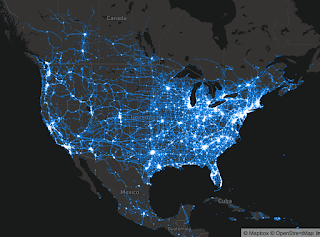
While one can't directly own locations on a map, we can indeed create facsimile versions of real space and thereafter build multiple virtual content layers atop that. In Mozilla (a non-profit open source web development company) we had a mapping initiative that allowed location based radio wave triangulation to be charted across multiple wavelengths (cell-tower for long range, wifi for short range) stored in a digital repository for developers to build upon. Called Mozilla Location Services, we were able to leverage public frequency radio triangulation for any place in the world that had telephony coverage to be a navigable utility layer for posting or pulling web content. We could then build our own content layers and mapping tools that could pin to locations in the physical world. 

What is the best user experience to navigate this “augmented” coordinate space? Unless a browser had a way of querying for location and rendering the pinned object or content, nobody would see it. My friend Ben Morrow, who has been studying the AR space for years, explained, “This is a search and discovery problem. You have to ensure that whatever space you're in isn’t overburdened by irrelevant AR content in your space, which would result in an ‘AR Garbage World,’ or if you’re in a sparsely curated space you don’t experience the inverse, an ‘AR Desert World,’ where there is nothing of value for you to draw from.” So to deliver this, there needs to be a public-visibility of assets that are available in a specific location through a passive or direct querying utility, but with acceptable level of user control and preferences to give the user filtering control of what needs to be seen, when. (Imagine strolling by a "discoverable object" at a coordinate near you. You might look for specific content, like a location-based list of places to eat near you. But in this context, can content surface to you without downloading a specific app bespoke for that content?) TV and terrestrial radio is a content layer of real-time streaming video/radio abstracted away from specific coordinate locations. The spatial web content layer would be overlapping directly in places that are shared by millions of people daily. Navigating those layers should be easier than downloading a unique viewer for each channel. We have thousands of individual apps right now that render specific views of locally posted data. But we don't have a standardized approach such that any one of those app viewers could tune into all the channels of the others the way a TV or radio can easily switch between radio wavelengths.

To build this shared-content layer, we need engineers, artists, business teams and shared standards for engagement and architecture across millions of personal navigation devices. Rather than the celestial businessman who seeks to chart the stars alone, we need creators with the philosophy of an open-source cartographer. When the world-wide-web of hypertext documents charted the course for our internet of today, it started with a small interlinked corpus of nodes, which then expanded exponentially in the 1990s as millions of contributors posted and linked their own creations with others. I remember early approaches for content sharing and navigation depended on web-rings where site hosts would link their content to other sites of known related content. Bloggers created their own specialized hubs of niche content. Companies like Yahoo, Excite and LookSmart hired hundreds of content curators to pull in sources of new content as the web grew. Netscape’s Open Directory Project and Wikimedia achieved similar content mapping databases for multiple languages around the world even without a corporate sponsored business model. Then once, the scale of web content grew faster than could be aggregated or charted efficiently a purely algorithmic model was needed to scale the corpus of the web efficiently, leading to the web crawlers and Boolean web query models we have for sifting content today.

Web search engines of today didn’t yield their value from a top-down approach, but rather a bottom up. They gained their utility for us by mimicking the way that web developers inter-link and label their content for discovery. Early algorithmic search engines (Altavista, Hotbot, Inktomi, Fast, Bing, Google for instance) would crawl the web much like a spider, following the way each thread of the web linked to every other and ascribing weighted value to different kinds of connections site hosts would paste into their html by way of “anchor-text links.” It was crowd-sourced in a way that made it more dynamic and resilient than any single company or group could create. 

The spatial web will be woven similarly, in a crowd-sourced way with location reviews of restaurant goers, measured velocity of sharing actions and graffiti-style content postings that happen in the physical world. The search engines of this cartographic space will prove their value by filtering millions of tread paths of those wandering its trails and leaving notations for others, reinforcing the well-trod paths as potentially of utility to others just like the keyword searching model we’ve become accustomed to, which replaced the editorially curated/recommended web indexes of the past.

While the location-based internet has had many exciting phases of evolution over the past decades, it is rising to a fever pitch these days as a broad array of well-funded companies are starting to plan new utilities to map digital services over our shared physical space. The current pace of technology advancement here is a fascinating rabbit hole of strategies for cartography enthusiasts like me.

I became particularly interested in cartography during my international travels (50 countries to date) when I would use tools derived from the Open Street Map's open source database of physical locations to plan, journal and photographically document my journeys. Sometimes I was able to find my way about with digital maps in a way that was not possible with market-available paper maps that I'd bought. (In many cases, the places I'd go were not mapped precisely by Nokia Here, Bing nor Google Maps in a useful way. For dense cities, those services are great. But for the digitally disconnected regions of the world, they don't provide the anticipated utility.) 

I care about expanding this portion of our technology because I believe there is tremendous good that we can do for our community, and those who come after us, by facilitating greater levels of information layering on our physical world and the chronicling of information that can be available to people anywhere specific at a moment's search. There are tremendous resources that we've created in the corpus of the web that are not directly accessible in a given location without particular forward-leaning effort with keyword querying of web content. That's something we can address with good tools and intuitive user experience models that make the web generally more applicable to the daily lives of people in specific places.

Now that Virtual Reality gaming has advanced to a relatively mature market, several companies are now pushing the 3D models of gaming engines (such as Unity and Unreal) to create simulated virtual overlays of the shared space we live in. You may be concerned about these advancements from a safety perspective, with good cause. Distractions can be a danger in any context. The hazards of digital overlays in the real world are already being tested by pioneering companies who will be mindful of this. With Niantic's gaming layer (discovered through mobile phone screens, and eventually digital glasses) there can be risks of people being distracted from real-world safety issues. Niantic themselves have taken care to ensure that users don't engage with their games in ways that would put them in physical danger. With the release of more eyeglass products from Snapchat, Nreal and Facebook Aria, we'll start to see more social utility, services and commerce advance this trend beyond the well-established use of Augmented Reality in the workplace, which has been the focus of earlier efforts of Microsoft, Google and Magic Leap. Just as the mobile phone and automobile industry have taken measures to reduce distracted driving, caused by the proliferation of mobile phone usage in the wrong contexts, we can anticipate the industry addressing our concerns about such distractions outside of the driving context as well as these "mobile glasses browsers" become common in public.

Yelp Monocle AR review overlay
It is very easy to have content layers that trigger in-app content specific to only one developer, the way that Yelp Monocle showed AR overlays of the real world camera view, but only showed Yelp content. But what will be the next giant leap is to see when content can be app-agnostic, the way web pages are. We already have the file formatting for representing spatial objects in a portable way. (kml and glb are 3D equivalents of jpeg/mpeg for instance) We next need to implement a shared/public hosting repository where digital assets can then be queried in a location by a means contextually relevant to the need of the user. Due to the cost of infrastructure necessary to support location content discovery, there needs to be an appropriate business model for sustaining the underlying architecture.

Before departing the Google Maps division, the Niantic project had an interesting angle for this. During the development of their first game, Ingress, I met the team at the San Francisco Game Developers' Conference. They explained that there was a commercial value to moving people around in places. If they were to place an Ingress portal in a location that happened to be a store, those people playing Ingress nearby might eventually walk into that store to buy something. So location-based incentives may be the economic value to a cartographic platform that could influence where people decide to go in a specific location. This is also of great value for travelers, who are actively looking for tips on how to discover a location and which places to visit, book lodging with, or discover culinary and cultural opportunities.

Around the same time as that conference, I'd learned of a company that was creating a real-world Pac Man game that would drop little digital treats on their driving game to encourage people to create a digital layer of mapping that they could claim to be their proprietary travel-based index of the world. At a TEDx talk in Silicon Valley their product manager described the perils map routing. She suggested that the Waze app could leverage the willingness to explore of their users, somewhat like a group of foraging ants, to "random-walk" the Earth until they knew the real-time travel velocity of every navigable path on the planet. It struck me that this was a slight ecological nightmare if it was gamifying the concept of driving the roundabout way, just for a digital treat, instead of navigating in a straight path, which would require the least expenditure of resources, even if not time. Perhaps over time the initial waste of the indirect-route incentive would lead to traffic reduction for subsequent users who might not have known about an alternative efficient route that was better than the route that a larger map service would recommend. Ultimately, Google decided that the gamified approach of Waze and the active "contributor" community of people reporting road hazards and route feedback was enough incremental value over Google Maps alone to merit an acquisition of the company, while the decided to spin off the Niantic project as a stand-alone company.

If you happen to be a VR enthusiast, you probably have seen the rich 3D environments that Google Earth have rendered specifically for VR-ready devices. You can fly though the streets of New York, Chicago or San Francisco seeing a spatially accurate depiction of these major cities. You may then be surprised to see that a similar level of effort has not been put into cultural or historically significant world locations. The reasons may seem obvious. The city-scapes are assembled using Google's lidar photography (Such as the cameras on Waymo cars) combined with known information about the buildings that make up the city's topographical 3D structure. Obviously you can't drive a Waymo car through Chichén Itzá. An altogether different approach needs to be applied. One of Google's contributors explained that for areas that are not navigable by car to map with lidar, you must use aerial photography with photogrammetry (stitching of photos from different angles) to create depth maps. Putting San Francisco on the map is therefore, very easy. Putting Chichén Itzá, Petra or Angkor Wat on the map is stunningly hard. It's a finite expense, but the benefit from doing it doesn't yet outweigh the cost of doing it. It's just a matter of time and logistics though.

Considering the economic problem that leaves so much of Google Earth unmapped in 3D relief, you might wonder how AR is going to be any different. This is an issue that a bunch of people are trying to solve actively right now. The good news is we can use the hive-like behaviors of humans to accomplish it, just like the Waze team did for the streets of the US. But there needs to be some benefit or value of participating that incentivizes people to do the contribution work necessary to make a good map. That's where people like me come in. As a mapping contributor, uploading photos, making reviews and leaving tips for travelers, I'm doing the necessary work to create the content rich location layer across that will eventually populate our smart-glasses, automobile dashboard screens and social traveling apps. 

If it all the work had to be done by advertising companies, then every location you go to you'd be hearing navigation tips like "Turn left at the Wendy's then go straight to the 7-Eleven, where you bear a right, you're at your destination when you can see a Home Depot on the opposite side of the street." All that overt advertising would probably drive attrition of the navigation tools because the heavily-sponsored environment is annoying and distracting over time. It reminds me of the skyscraper in Hong Kong that for years had the giant text "AD HERE" on its Kowloon-facing side. The incentives need to be subtle, like the "Pokémon Go Incense" and "Poké-lures" that Niantic provides for individuals to draw customers to the proximity of commercial businesses when they need foot traffic. It's more appropriate to leverage context without being so overt as to say, "To get your next Poké Monster, walk into the store next to you and buy a soda, scanning the QR code on its side." You may in fact do those things of your own volition. But being instructed to to them in order to unlock a level of a game is annoying.

While these incentive schemes work well for large companies with a broad user base, smaller developers and content creators will have a challenge trying to create real-world content publishing. For instance, if I had a large photogrammetry map of Chichén Itzá, how could I get that content to someone who could benefit from it? Generally, I'd have to have a content marketing strategy to try to find the person who needs it when they need it. I'd have to place marketing materials at the locations where the need for that 3D map might arise, in the real world, or do marketing campaigns in search engines or travel portals to let people discover it. So not only do I have to pay all the money necessary to accomplish the 3D map generation, I have to ensure people can find it. That's a particularly baroque undertaking. There are indeed people who are working on the first part of the problem, making the 3D models with lidar and photogrammetry stitching for the benefit of posterity. Yet people with those talents don't typically have the marketing savvy to address the discovery side of the user experience. That's where the free-to-index search architecture that popularized sites like Yahoo!, Bing and Google come in. But the mechanisms that made those companies possible can't be directly extended to solve this search challenge. A new means of sifting data needs to be deployed for this case.

Fortunately the market is evolving significantly to the point that the fundamental tools of AR app development are available cheaply to any developer. But the free-to-index public repository for location-based content is not yet solved. A few candidate approaches have been proposed in different countries. In Japan, Tonchidot suggested the approach of a generally discoverable "air tag" with coordinates and content types that could be visited by a user with idle time using an app capable of posting and rendering the content. 

In the US, QR-codes are typically used to engage location or topic-specific content queries from a physical sticker or billboard. The team at Verses Labs proposes a global domain registry approach for location mapping that is similar to the DNS lookup table approach of the Internet domain registry legacy model. (The administrative body for DNS registrations is called ICANN.) Recently, an Estonian company, Over Holding, has proposed a concept whereby developers share a blockchain record of location assets with a tenancy privilege for developers who publish to or buy the location "hexagon" where the AR content will be placed. This isn't meant as NFT land grab hype. They envision a model whereby virtual estate needs to be able to fluctuate up and down in price in a means similar to the open competitive market that defines price of physical real estate that it is emulating. What Clear Channel (US) and Ströer (EU) is to the physical advertising world in billboard marketing, they'll mimic with digital equivalent of "rights to display" in the shared space that developers leverage on their digital monetization architecture. 

While the ICANN domain registry approach yielded many free market search engines in the past, this could be an exceedingly complex centralization effort to run for the entire globe. Whichever approach for location-based posting/indexing emerges, it will need to develop defenses just like the web-index techniques for spam prevention, content preferences, filtering and ephemerality/freshness if it is to become valuable and beneficial to us on a broad scale.

It will be interesting over the next few years to see how the discoverability and publishing rights for location advance. It's too early to tell whether we'll stay in-app for the next decade or go toward one of these more decentralized models for content sharing. A few more companies need to jump into the pool before a good standardization effort for cross-platform content visibility and share-ability emerges. While it may seem a Sisyphean effort to chronicle and map the world when we don't know yet what the eventual shared standard is going to be, I think it's a valuable expense of resources for the web of tomorrow, which should ideally be specifically relevant to us based on where we are, not just who we are.


Saturday, August 14, 2021

Bridging the uncanny chasm

I remember my first experience visiting the Oregon Museum of Science and Industry in Portland when I was a teenager. I had always been fascinated with sciences. So a playground of interactive exhibits with hands-on experiments was just my kind of thing. I particularly recall my first meeting a conversational chat-bot that they had installed which could output considerate responses to questions the user typed in. Dr. Know, as it was affectionately named, was an instantiation of the Eliza program from MIT Artificial Intelligence Laboratory. It was an example of a Turing test, an idea put forward by Alan Turing, an early pioneer in computer programming. He theorized that computers would eventually be indistinguishable from humans once their logic structures matched those we form through socialization processes. The Turing test is a process of inquiry followed between a human and a robot that would be used to figure out if the robot was sentient or not. (Ironically, on the internet, servers spend a considerable amount of time giving internet users Turing tests before they allow us to view websites. These "Completely automated public Turing tests to tell computers and humans apart," CAPTCHAs for short, are meant to lessen the amount of time that web servers spend dialoguing amongst themselves without benefiting humanity in some way.)

These days, a majority of American households have at least one device that is capable of representing an interface to a conversational virtual assistant. Computer vendors have embedded speech-to-text inputs in hardware they vend to encourage us to speak questions to their respective cloud service virtual assistants. (Cortana, Siri, Alexa, Alice, Google Assistant) Their goal is to eventually obviate the need for keyboard entry for the next generation brain-computer interfaces. Staring at phone screens can be fun. But it can distract humans from leading normal lives rich with interpersonal social interaction, with humans. A lot of our time each day we spend talking through our fingers using secondary representations of language. If enough people offer up their voice patterns, computers can learn all accents to thereafter bypass the alphabetic language we typically type at them. Once they speak the same language as us, without the distance of the plastic/silicon intermediary of the computer screen, our near and distant relationships will return to a more normal means of communicating, and we’ll spend far less of our lives communicating through finger gestures.

Each of us have had our own experiences conducting Turing tests with machines in the home or on phone lines, trying to navigate their logic structures and capabilities. I’ve seen lots of failed attempts to bridge what Masahiro Mori called “The Uncanny Valley” of foreignness that divides humans and machines, preventing them from forming comfortable trust-based relationships. I’m fascinated to watch the emotions people use to express themselves when they know their counterpart is not human. I’m impressed with the tricks the tech companies use to embed implied emotion through tone of voice their virtual assistants speak at us. Ironically, it’s usually the humans that sound like robots in these interactions, with flat matter-of-fact insisting rather than sing-song tone of voice typically used among fellow humans we seek to convince, sway or implore. 

Some people bristle at the idea that we would refer to a machine-learning algorithm plus a database as an artificial intelligence. It is as if the term intelligence needs to be an honorary title conferred only on those of us that have and express emotion, beyond vocal inflections. When I was testing the Turing computer in OMSI (or it was testing me) I was enthralled to see that the machine could grapple with the rules engine we use to socialize. The size of its knowledge database didn’t matter to me so much as its deft capability to generate an acceptable output response to well-framed questions. It took me about 30 minutes before I had mapped out the logic frameworks the programmers had used in the conversational flows. I could eventually predict how it was going to answer any question I posed. After that happened, I became satiated that I understood this mechanical friend well enough and I could go on with my day.

As children, we interface with the world intensely to find the external connections that give us pleasurable or negative reactions. I walked away from Dr. Know feeling like it had dead-ended too many of my questions. I'd gotten to the end of the dialog maze. It's a similar experience to what a lot of us have with smart speakers these days. They sometimes can’t progress in a dialog unless we buy something or augment them with some third party “skill” not readily on hand. As we come to depend more on virtual companions we don't want to hear, "I'm sorry Dave, I'm afraid I can't do that" when we're facing time-critical challenges. Human patience has a much shorter fuse than bot patience.
 
I recently joined a company, Akin, that is developing AI for use in assisting people with exactly those time-critical decisions and actions. My team, who formerly worked on the Watson platform at IBM, are extending the use of AI technology to help engineers working in complex assembly contexts and in families coordinating inter-dependencies across the family unit. Watson is the conversational AI that was designed, like Eliza, to banter back-and-forth in dialog with random questions. It was famous for beating Jeopardy champion Ken Jennings at his own game. Knowledge games are an area where AI can outmaneuver humans increasingly over time as Moore’s Law of increasing computer power favors machines. Humans can’t scale at the same rate unless they augment their capacity with external data sources, other people, or data from the internet.

AI platforms can be specifically good at repetitive tasks, (Set a timer; Turn on lights; Turn up the volume) state monitoring (Weather forecasts; There's somebody at the door; Your package will arrive tomorrow). AI assistants can enhance our effectiveness by helping to stay on task and focused to avoid distraction. Beyond just assisting, we are learning more creative applications of AI where they are able to significantly advance in fields of inference such as pattern recognition, protein folding and vaccine creation. The more we can delegate tasks to AI, the more we free the human mind from burdensome task management so that our minds can exercise their own strengths.

I look forward to the point that we can engage and collaborate more with our in-home AIs. Relationships thrive when the output is more than just the sum of inputs. We want to have robotic assistants that do far better than just what they’re told, or respond factually to what they’re asked. Just as friends propel us to maximize our own personal potential, AI assistants should be able to amplify our efforts toward a goal. To do this they have to get beyond our human tendency to repel things that are uncannily familiar. We need to find ways to let them draw closer, allow us to invest more of ourselves and rely more on them. In order to build trust with Akin’s AI assistants, the founders have incorporated as a public benefit corporation and are working with universities and health researchers to measure the quality of life benefit that results in using Akin AI in the home. 

We look forward to sharing more of our advances over the coming years.